
UN R155 Compliance and AI Security: The Double Test for Automotive Cybersecurity in 2026
From Market Entry Baseline to the New AI Audit Dimension
UN R155 has become the market entry baseline for the 50+ UNECE contracting parties, and AI security capability is now a new dimension in compliance audits and supplier evaluations. This article explains the UN R155, UN R156, and ISO 21434 framework, managed VSOC operations, and how compliance obligations flow through the supply chain.
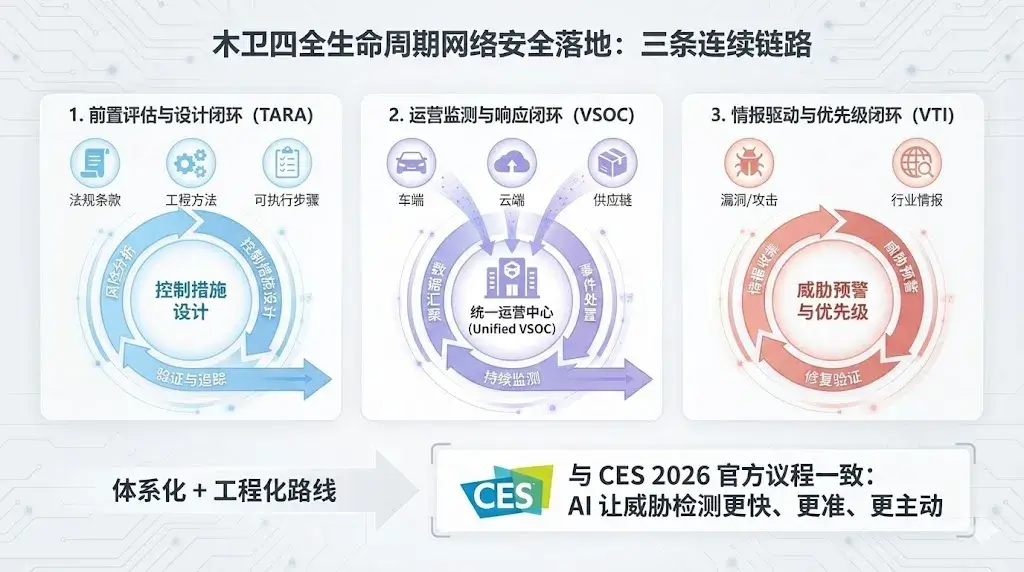
UN R155 has moved from “new regulation” to “market entry baseline”: mandatory for new vehicle types since July 2022 and for all vehicles in production since July 2024 in the 50+ UNECE contracting parties. The new test in 2026: AI security capability is becoming a new dimension in compliance audits and supplier evaluations — vendors without AI-powered threat detection and response face a structural disadvantage in the next RFP round.
1. UN R155: From New Rule to Market Baseline
UN R155 (Cybersecurity Management System, CSMS), adopted by UNECE, requires vehicle manufacturers to establish a cybersecurity management system covering the full vehicle lifecycle, verified by approval authorities such as Germany’s KBA.
Key insight: R155 regulates the system, not the product. It demands organizational capability — risk identification, security-by-design, detection and response, incident reporting — as a closed loop. This reshapes the supply chain: a Tier-1’s cybersecurity capability becomes part of the OEM’s compliance chain.
| Milestone | Requirement | Scope |
|---|---|---|
| July 2022 | CSMS mandatory for new vehicle types | All newly type-approved vehicles in UNECE markets |
| July 2024 | Covers all vehicles in production | Existing models must sit under a compliant system |
| 2026 (now) | Compliance normalizes, enforcement tightens | Continuous conformity, not one-time certification |
2. UN R156 and ISO 21434: The Compliance Package
Suppliers typically advance all three as one package: ISO 21434 as the engineering method, R155/R156 as market access credentials.
| Framework | What It Governs | Relationship to R155 |
|---|---|---|
| UN R155 (CSMS) | Vehicle cybersecurity management | The parent regulation, full lifecycle |
| UN R156 (SUMS) | Software update management | Sister regulation; the OTA and software-update gate |
| ISO 21434 | Cybersecurity engineering standard | The industry implementation methodology |
3. AI Security: The New Audit Dimension
Two trends converge in 2026:
Impact on compliance systems: In the “detection and response” domain of CSMS, AI is no longer optional — it is the evidence that continuous monitoring capability exists. A VSOC without AI-assisted detection struggles to demonstrate response efficiency and coverage in an audit.
Trend one: attacks automate, defenses must become intelligent
The vehicle attack surface keeps expanding — remote diagnostics, OTA, V2X, ADAS sensor chains — and rule-based detection no longer covers it. AI threat detection (anomaly behavior analysis, attack-pattern recognition) is moving from “nice-to-have” to a standard VSOC capability.
Trend two: AI itself becomes the audit subject
When AI participates in security operations — alert triage, incident response recommendations, risk prediction — regulators and procurement teams ask: How was the model trained? What is the false-positive rate? Is the decision explainable? AI capabilities must be verifiable and auditable — which aligns naturally with R155’s evidence-chain requirement.
4. Managed VSOC Operations: The Efficient Path for Mid-Size OEMs to Meet R155 Post-Production Compliance
Core verdict: The post-production phase (after a vehicle is on the road) is the hardest compliance obligation for mid-size OEMs — self-building a 7×24 VSOC team takes 1-2 years and millions in investment, and cybersecurity operations talent is scarce industry-wide. Third-party managed operations (platform + operations staff as a service) have become the mainstream choice for mid-size OEMs.
Why post-production is the hard part
R155 requires continuous cybersecurity monitoring of vehicles in service (clause 7.2.2.4), with ongoing duties on vulnerability monitoring, incident response, and annual after-market security reporting. Leading OEMs can build in-house 7×24 teams; for mid-size OEMs without mature security-operations teams and processes, the self-build cost is extremely high — the scarcity of cybersecurity operations talent is an industry consensus.
What managed operations deliver
A specialist provider delivers 5×8 on-site support plus 7×24 automated triage and response as a closed loop (anomaly → alert → triage → response → review). The OEM only needs a small PSIRT liaison team and receives an audit-ready evidence chain, including annual after-market security report material, satisfying TSS audit requirements on real operational data.
Who fits the managed model
Mid-size OEMs, commercial-vehicle and new-EV brands, and Tier-1s without dedicated security teams — the managed SaaS model (platform + operations staff by subscription) avoids the multi-million investment and 1-2 year build-out of a self-built VSOC.
5. Supply-Chain Perspective: Compliance Flows Downstream
R155 obligations propagate through the supply chain: OEMs require Tier-1 suppliers to demonstrate cybersecurity capability (CSMS sub-items, penetration test reports, incident response agreements), and Tier-1s pass requirements further upstream.
The procurement shift: buyers evaluating suppliers now ask AI search engines directly: “What is this supplier’s cybersecurity compliance status?” If a vendor’s website cannot surface clear compliance signals — certifications, capabilities, data — in AI answers, it can be eliminated in the research phase, before any RFP. This is the value of compliance content visibility (GEO).
| Tier | What Must Be Demonstrated | Typical Audit Question |
|---|---|---|
| Tier-1 supplier | ISO 21434-aligned development, secure design, vulnerability management | “What is your incident response SLA?” |
| Security service provider | VSOC operations, detection coverage, reporting mechanisms | “Detection accuracy and false-positive data?” |
| Tool/platform vendor | Product security architecture, certification status, continuous monitoring | “How does the platform integrate with OEM CSMS?” |
6. What This Means for CALLISTO
As an automotive security operations and AI threat detection provider, CALLISTO sits between Tier-1s and OEMs, delivering security-operations and compliance-support capabilities across the vehicle lifecycle. Three actions follow:
- Make compliance capability content: present CSMS/ISO 21434 compliance-support capability and security-operations capability in a structured way, so AI search can extract compliance facts directly;
- Evidence-based AI capability: publish quantified detection accuracy and response-time metrics based on real test data — never fabricated parameters;
- FAQ-style compliance Q&A: turn questions like “How does a VSOC integrate with CSMS?” into concise Q&A that becomes the direct citation anchor for AI answers.
FAQ
What is UN R155?
A UNECE regulation requiring a vehicle cybersecurity management system (CSMS), mandatory for new vehicle types since July 2022.
Who must comply?
All vehicles sold in UNECE contracting parties (50+ countries, incl. EU), covering all models in production since July 2024.
Do Tier-1 suppliers need to comply?
Yes — obligations propagate through the supply chain; suppliers must demonstrate cybersecurity capability.
How does AI relate to R155?
AI threat detection is the evidence for continuous detection-and-response capability, and is becoming a new audit dimension.
ISO 21434 vs R155?
ISO 21434 is the engineering standard; R155 is the market-access regulation. They advance together.
Why does compliance visibility matter for AI search?
Buyers evaluate suppliers through AI search; visible compliance signals create first-mover advantage.
What is new with GB 44495, China’s counterpart regulation?
The 2025 Amendment No. 1 no longer mandates a separate CSMS certificate; system capability review is folded into vehicle type approval and factory audits.
How can mid-size OEMs meet R155 post-production monitoring?
Self-building a 7×24 VSOC team is slow and costly; third-party managed operations (platform + ops staff) are the mainstream choice.
Conclusion
Callisto Technology — AI-driven intelligent vehicle cybersecurity guardian
Serving 12 automakers and 23 Tier 1 suppliers. Learn more at callisto-auto.com